
Can Facebook Work For Brands?
The debate about the best way for brands to engage, use and market with Facebook is raging as the social networks 700m strong userbase firmly places it on every marketer's radar. In this controversial guest blog by Mark Rogers of Market Sentinel, he investigates the numbers, the reality and gives brands 3 simple rules.
All this summer we have been looking at the effectiveness of Facebook for a variety of big brand customers. Here is what we have discovered, and for Facebook it doesn’t make pretty reading.
Facebook ads don’t work for brands
Even with the ability of the user to determine how and to whom an ad is served with great demographic accuracy, Facebook ads have click-through rates of only 0.011-0.165%, compared to Google’s 0.4-0.7%.
A former Facebook intern, Cliff Chang, with disarming candour, admitted to this on the question-answering site Quora. Explaining why Facebook had taken down its own conversion-tracking tool, he admitted:
“Some hilarious percent of people who generated pixels never received a single impression on them.”
If Facebook can’t compete strongly as an advertising platform it won’t be able to dislodge Google’s dominance in internet advertising (in 2010, Google owned 38.9% share of US online ad revenue, compared to 4.7% for Facebook, and eMarketer estimates that Google’s share will increase to 43.5% in 2011). The appearance of Google+ means that Google may finally be able to add an element of social proof to their own search results, diminishing Facebook’s USP.
Facebook fan pages don’t work for brands
Facebook fan pages provide a great opportunity for celebrities like Lady Gaga and Taylor Swift to reach their adoring public. These pages have eye-catching headline figures for the number of “likes” they attract. However, we recently found that the vast majority of “fans” don’t actually interact with the Page.
We surveyed the 20 most-fanned celebrities on Facebook and found that the number of “core fans” is far lower than the actual fan count. (Here, we define “core fans” as fans who have commented more than average for the Page[1].)
The table below shows the data as of 12 May 2011. Eminem had over 41 million fans and Lady Gaga over 39 million fans, but their core fan counts are 575 and 1,231 respectively (just 0.001% and 0.003% of their overall fan numbers).
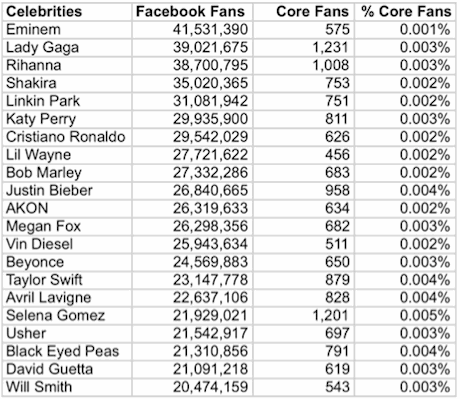
Chart Source: Skyttle Friends.
These numbers are significant because of the way content from fan pages syndicates into Facebook users’ news feeds.
Unless someone has actively interacted with your page, they won’t receive your updates. Many brands launch a Facebook contest to boost their fan count, assuming that their future updates are now reaching the thousands or millions of people who clicked “like”. But that’s not how Facebook works.
Unless a fan actively participates in a brand’s Facebook Page and their activity on the Page has been continuous, the brand’s status updates will cease appearing in the fan’s Facebook stream.
Facebook is a great CRM network for brands who know how to use it, but most don’t.
Sheryl Sandberg of Facebook boasts of the 50 million “likes” a day which brands receive on Facebook. She is being disingenuous. There are few ways for brands to take advantage of this. Brands can’t access the list of fans who “like” them. Brands can’t examine what else these fans like (since Facebook’s F8 update, the graph API no longer allows it). Brands can only address these fans for a short window after the initial “like”. The bald truth is that a “like”, in 99.99% of cases, does not presage further interaction with the fanpage.
Apps should work for brands, but often don’t
A well-designed application on Facebook can produce a Niagara of valuable data about users, but only if:
- users download it
- they opt in to sharing data
- there is an “off-ramp” leading them to spend money on the brand.
Brands who have taken good advantage of this include film studio Warner Brothers, who delivered The Dark Knight as a pay per view Facebook rental and brand Starbucks, whose application has over 45,000 active users (and an all-time high of over 760,000 monthly active users according to appdata.com). But most brand applications do not follow through with serious ROI. No branded app (outside those from telcos and tech businesses with skin in the game) makes Facebook’s top 100.
The three pillars to Facebook’s business model we have examined all have major question marks over them. Advertising click-throughs are low, brand presence is a poor fit for the functionality of the fan page, and applications, whilst effective, are poorly understood and exploited by few.
It is clear that Facebook can be a great business. It could carve out a terrific niche delivering qualified audiences to entertainment brands who launch successful movie, TV and music channels. These brands will share some of that revenue with Facebook. It could offer a transactional interface based on local search, as Havas boss, David Jones has suggested. This would be supported by new location-based ad targeting functionality. But the critical thing about these revenue sources is that they are in the future, they are unproven. Facebook is widely rumoured to be going to market now with a valuation of $65bn. That valuation is hard to support until Facebook provides proven, public answers to the questions about how it’s going to generate bucks for brands.
[1] To compute the core fan count, we calculate the average number of posts-per-contributing fan. This number ranges from 1.14 for Bob Marley to 2.03 for Bob Marley. Any fan whose comment count is higher than the average is a “core fan”. As you can see it doesn’t take much to become a “core fan” by this measure, making the low totals even more notable.
Original blog post Can Facebook work for brands? by Mark Rogers, Market Sentinel @marketsentinel, reposted with permission. Photo (cc) Adam Crowe.