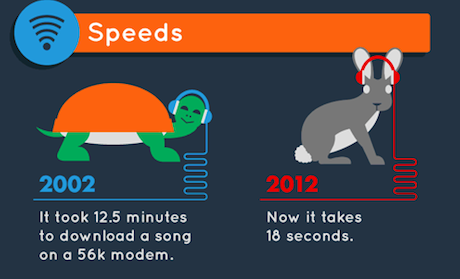
Do you ever find yourself missing the dulcet tones of dial up?
Lamenting those lost 20 minutes spent rapping your fingers on the desk, waiting for a picture of Jennifer Aniston to load, just so you can show your hairdresser the "Rachel"?
Of course not. Isn't it amazing though just how much the internet has changed in the last ten years?
Back in 2002 there was just 569 million internet users tapping away for a mere 46 minutes a day. Ten years later and there are 2.27 billion, that is 300% more of you, out there surfing the web for 4 hours a day. (It probably helps that we don't still pay per minute.)
The number one internet search of 2002 was Spiderman, in 2012 it was Rachel Rebecca Black. So well done everyone, that tone-deaf young lady couldn't have made that happen on her own. I hope you're proud.
In 2002 Blockbuster missed the chance to snap up Netflix. Current vaulation? $5.5bn.
The decade's bell is tolling final orders for music retail on the High Street with Tower Records' 200 stores hitting the dead pool. Virgin Megastore proving not-so mega and the chances of hmv making the next infographic? Slimmer than slim.

22 January 2013 by Fleur Fine Hosken

Bloggers
- Alex Chapman (8)
- Alex Gillett (1)
- Alex Sass (8)
- Amy Wilson (1)
- Andy Hinder (1)
- Angus Phillipson (3)
- Ben Peacock (1)
- Benjamin Ellis (19)
- Benn Achilleas (7)
- Bex Clarke (8)
- Bootlaw (1)
- Borz Farahani (1)
- Chinwag News (100)
- Chinwag Team (90)
- Chris Bradley (1)
- Ciaran (1)
- Claire Black (1)
- Colin O'Malley (1)
- Colleen Thomas (1)
- Dan Jacobs (1)
- Dan Mortimer (1)
- Danielle Dalkie (6)
- Danny Bluestone (2)
- Dave Williams (2)
- David Rowden (1)
- Deirdre Molloy (16)
- Diana Gray (1)
- Diana Yeboah (3)
- Dominic Campbell (1)
- Dr KF Lai (2)
- Emily Fisher (5)
- Fiona Du Vivier (1)
- Fleur Fine Hosken (25)
- Francesca Heath (50)
- Grace Park (1)
- Graeme Harvey (1)
- Guy Rigby (1)
- Harriet Mumford (1)
- Hattie Nicholson (5)
- Hermione Crease (1)
- Jamie Riddell (12)
- Jason Burrows (1)
- John (1)
- John Horsley (5)
- Jonathan Wardle (1)
- Julia Eilon (2)
- Julian Grainger (1)
- Julian Ranger (1)
- Kate Jackson (6)
- Kay Hammond (2)
- Lauren Cotton (167)
- Lauren Macready (17)
- Liam Moore (1)
- Luke Mitchell (2)
- Luke Walker (1)
- Mellissa Norman (2)
- Michael Silverman (1)
- Mike Teasdale (4)
- Nichola Stott (1)
- Nicky Swain (6)
- Nikki Barton (5)
- Phil Haslehurst (1)
- Rebecca Rosman (26)
- Richard Woods (5)
- Russell Zack (1)
- Sam Michel (365)
- Sam Turner (1)
- Sarah Al Zawqari (3)
- Sarbjit Bakhshi (2)
- Scott Allison (1)
- Scott Meyer (3)
- Shannon Lee (2)
- Sherrod Dine (1)
- Simon Caine (20)
- Simon John (1)
- Stephanie Himoff (1)
- Suzanne Morrow (51)
- Tim Ash (1)
- Tim Butler (1)
- Tom Smith (1)
- Tony Lawes (1)
- Verity Hosken (1)
- marc duke (2)
Archive
- May 2013 (15)
- April 2013 (35)
- March 2013 (29)
- February 2013 (21)
- January 2013 (22)
- December 2012 (10)
Chinwag on Twitter
Chinwag Newsletter
Updated Chinwag Profiles
- Wing Spears - today home loan rates
- rama lakshmi - ANGLER Technologies
- Harriet Mumford - Nelson Bostock Communications
- Zavala Zavala - http://www.fotografodebodas.es/
- Luke Mccall - SharePoint Consultants


Comments
Not sure this is a true reflection of 2002
I am admittedly an internet professional and have been further down the curve than most, but I am not sure that some of these figures are a fair representation of internet user s only 10 years ago.
An awful lot of people I knew (who were not internet professionals) who were internet users were already using faster connections than dial up back then, and also Wi-Fi (whilst not common) was available, and so your figures for connection speeds don't match my recollections at all. Similarly your figures for downloading (presumably from Napster or one of the other Peer 2 Peer file sharing sites that have since been shut down) don't correlate with what I remember everyone around me doing.
You are right that Internet Explorer was dominant in 2002, but if you go further back you will see that the dominant browser was the now defunct Netscape. The point is that the browser choices are constantly evolving and constantly in flux. What is hot today could be a memory tomorrow if somebody makes a new browser that taps into a hitherto ignored user preference. What is more interesting is to look at the technology companies you used then and now. Back then Microsoft and Intel would have been dominant with Yahoo prominent and a young upstart called Google steadily gaining in popularity. Today that will be standing on its head with Apple, and Google standing supreme, Microsoft looking like their older, fatter and less attractive companion and Yahoo practically consigned to the side-lines.
Your search terms do highlight that the internet was used as a source for information on things that have happened or are planned, whereas now it is a prime source for news and information as it happens, and this is a fundamental paradigm shift which has affected everyone's lives and requires new ways to assimilate them into everyday life.
I'm also not sure I agree with your comparison between Friendster and Facebook, as the most popular form of social activity in 2002 was blogging. Here we see an open and uncontrolled method of self publication replaced with a closed, controlled and some might say 'owned' method of self publication. Again there is a fundamental shift from the user as a publisher of content to the user as the product being sold. That to me is a far better representation of how things have changed.
Software was the first industry to be affected by the Internet, and moved from a boxed license sales network of retailers, dealers, distributers and software houses, to what is effectively a shareware model with very little network or structure needed to support it.
The next industry was music and entertainment, and this demonstrates a shift from shop purchased format based publications to digital material which is protected against format obsolescence.
Your list of companies which have gone to the wall in a decade hints at this story but doesn't make the point that consumers were ahead of the companies and it was myopia which was the seed to their destruction, not a simple acquisition missed. If Blockbuster had created their own digital entertainment delivery (or just had delivery drivers) they would have been well placed to own the space and nobody would have heard of NetFlix or Love Film. As it is, smarter people than they came along and redefined the category with the result that the dinosaurs died.
Sorry to go on at length but I hope you find my offers interesting and that it adds to the story.
All the best
Rebecca Black.
Rebecca Black.
Post new comment